Poké-Body
Exoskeleton
Any damage done to Kakuna by attacks is reduced by 20 (after applying Weakness and Resistance).

1 / 25 collected
Any damage done to Kakuna by attacks is reduced by 20 (after applying Weakness and Resistance).
The Defending Pokémon is now Poisoned. Flip a coin. If heads, search your deck for an Evolution card that evolves from Kakuna and put it onto Kakuna. (This counts as evolving Kakuna.) Shuffle your deck afterward.
missing
missing
Artwork is identical across finishes; the holo or reverse shimmer is indicative.
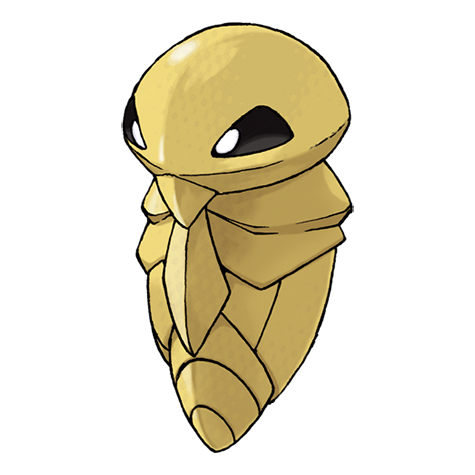
Kakuna is the Cocoon Pokémon, the second-stage evolution of Weedle and the pre-evolution of Beedrill, representing the pupa phase of an insect's life cycle. It remains almost completely immobile, hardening its shell while its body…
“While awaiting evolution, it hides from predators under leaves and in nooks of branches.”
Kakuna is the Cocoon Pokémon, the second-stage evolution of Weedle and the pre-evolution of Beedrill, representing the pupa phase of an insect's life cycle. It remains almost completely immobile, hardening its shell while its body undergoes transformation inside, though it can extend its stinger to poison threats when endangered. Internally it is reportedly soft and warm as it prepares for evolution, and it commonly inhabits forests and woodlands like Viridian Forest in the Kanto region.
The Japanese name コクーン (Cocoon) is a direct katakana transliteration of the English word 'cocoon,' referring to the protective casing a larva forms during its pupal stage. The English name 'Kakuna' is likewise derived from 'cocoon,' possibly blended with 'encase' or simply stylized to sound more like a proper name; some interpretations also connect it to the hardened shell that encloses the developing Pokemon. Both names emphasize its identity as a dormant, encased life stage.
The Kakuna cards already in your collection.
Every Kakuna print in the catalogue, including promos and cards from other series.